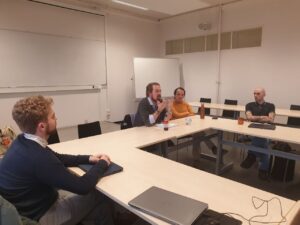
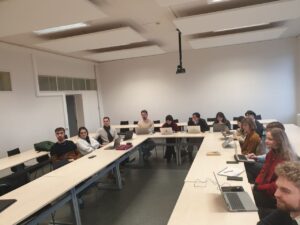
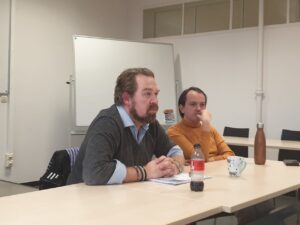
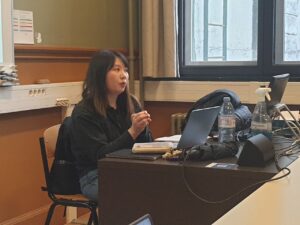
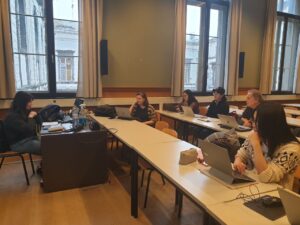
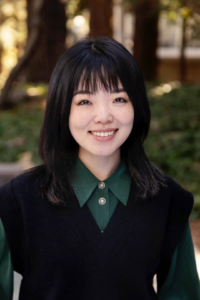
Reading group meeting, presentation by Wushi Lin, October 23, 2025

The next phase of the Reading Group convened on October 23, 2025, marking the first of three sessions dedicated to the study of materials prepared by Wushi Lin, a joint PhD student of Professor Bart Dessein (Ghent Centre for Buddhist Studies) and Professor Weijen Teng (Department of Buddhist Studies, Dharma Drum Institute of Liberal Arts). The materials focus on the epistemological interpretation of the no-self doctrine by the influential late Ming dynasty Buddhist monk Zibo Zhenke (紫柏真可, 1543–1603), and are part of Wushi Lin’s PhD project, “Comprehending Everything as Oneself: The No-Self Doctrine of Zibo Zhenke in Ming Dynasty Buddhism.”

Guest lecture “Resituating the Yogācārabhūmi Corpus: Potential Gandhāran Links and Sūtra-Grounded Practice” by Keiki Nakayama, November 13, 2025

We are delighted to announce that the fourth lecture in our ongoing “Gandhāra Corpora Project Lecture Series” will be delivered by Keiki Nakayama from the University of Leipzig. The lecture series is organized by Prof. Charles DiSimone, leader of the ERC-funded project “Corpora in Greater Gandhāra: Tracing the development of Buddhist textuality and Gilgit/Bamiyan manuscript networks in the first millennium CE” at the Ghent Centre for Buddhist Studies.

“Resituating the Yogācārabhūmi Corpus: Potential Gandhāran Links and Sūtra-Grounded Practice”

Keiki Nakayama, University of Leipzig

Nov 13, 2025 @ 17.00 CET

Location: Faculteitszaal, Blandijn
faculteit Letteren en Wijsbegeerte
Blandijnberg 2
9000 Gent

To attend remotely, please register through this Google Form.

Abstract:
The Yogācāra school, together with the Madhyamaka, is well known as one of the two major streams of Indian Mahāyāna Buddhism. Yet its foundational text, the Yogācārabhūmi, contains numerous passages that follow the modes of description characteristic of the Śrāvakayāna tradition. The author(s) of this work are thought to have belonged to a lineage that transmitted the Mūlasarvāstivāda Vinaya. Thus, while the Yogācārins were moving away from the Sarvāstivāda mainstream, they also inherited many of its scholastic and disciplinary elements.
The first part of this presentation reconsiders the position of the Yogācārabhūmi—and hence early Yogācāra—in relation to the Sarvāstivāda tradition. The Yogācāra school appears to have shared doctrinal affinities with internal Sarvāstivādin groups such as the Dārṣṭāntikas and Vibhajyavādins mentioned in the Mahāvibhāṣā. Focusing on the Gandhāra region, I examine evidence suggesting that the “Western Masters” (Pāścāttyas), associated with Gandhāra, held positions that coincide with those of the Yogācārabhūmi, thereby indicating possible intersections between Yogācāra and Gandhāran Buddhism.
Later but related materials include numerous Mūlasarvāstivāda Vinaya manuscripts discovered in Gilgit, part of Greater Gandhāra. These texts notably embed a variety of sūtras. If the sūtras employed in the Yogācārabhūmi correspond to those appeared in the Mūlasarvāstivāda Vinaya, this strengthens the view that the Yogācārabhūmi originated from a tradition closely linked to the transmitters of the Mūlasarvāstivāda Vinaya. The recently studied Dīrghāgama (Long Discourses) manuscripts from Gilgit also deserve attention.
The latter half of the talk examines how the Yogācārabhūmi actively incorporates and reinterprets sūtras within its structure of practice. Focusing on the Śrāvakabhūmi, the earliest stratum of the text, I argue that the Yogācāra school, though renowned as meditative practitioners, grounded their practice in close engagement with the words of the Buddha.

Bio
Keiki Nakayama is a guest researcher and lecturer at the Institute for South and Central Asian Studies, Leipzig University. Having recently fulfilled the requirements for a PhD at Kyoto University, he is currently conducting research on the interpretation of canonical scriptures within the Yogācāra school, supported since 2023 by the Bukkyō Dendō Kyōkai (BDK). His publications include a co-authored article with Jens-Uwe Hartmann, “One Hundred and Eight Distinctions of Craving: The Tṛṣṇā-sūtra of the Saṃyuktāgama,” in Mind, Text, and Reality in Buddhist Studies: Engaging the Scholarship of Rupert Gethin (Bloomsbury, 2025), and a co-authored monograph with Izumi Miyazaki et al., The Seventy-five Elements (Dharma) in the Madhyamakapañca-skandhaka, in Bauddhakośa: A Treasury of Buddhist Terms and Illustrative Sentences, Volume VIII (The International Institute for Buddhist Studies, 2022).

Guest lecture “War Memorials and Religion in Japan: Separation of Religion and Politics and the Role of Scholars” by Akira Nishimura, October 23, 2025

We are pleased to announce an upcoming lecture by Dr. Nishimura Akira (Associate Professor of Religious Studies, University of Tokyo), who has been a visiting scholar with us over the past two months. Dr. Nishimura’s talk will explore the complex intersections of war memorialization, repatriation of human remains, and the pivotal role played by temple communities in these processes—an issue of particular relevance to scholars of Buddhism and religion. He will also address the responsibilities and ethical engagement of religious scholars in such sensitive contemporary debates. The lecture will take place on Thursday, 23 October at 16:30 in the Faculty Room. All are warmly invited to attend.


New member: Dr. Kikee Doma Bhutia

Please join us in welcoming Dr. Kikee Doma Bhutia, who, having won the FWO Junior Postdoctoral Fellowship, will be with the Ghent Centre for Buddhist Studies for the next three years. Her project, “Local Deities, Natural Disaster, and Ritual Waste in Vernacular Buddhist Practices in the Himalayas,” project examines the intersection of local religious practices, environmental policies, and waste management in Sikkim, with a particular emphasis on the influence of Buddhist rituals and beliefs on the community’s approach to sustainability.

Despite its relatively small geographic size, Sikkim has emerged as a leader in environmental initiatives, including the prohibition of plastic and the promotion of eco-friendly practices. However, traditional rituals, such as the tying of prayer flags and the use of synthetic materials in religious offerings, pose significant challenges to environmental conservation. This research investigates the roles of local deities, vernacular Buddhist practices, and monastic institutions in waste management, analyzing how religious concepts are integrated into environmental policies. Utilizing ethnographic fieldwork, interviews, and archival research, this study will explore how communities navigate the complexities of modernization and tradition, thereby contributing to academic discussions on waste, religion, and sustainability in the Himalayas. The project aims to produce scholarly articles, presentations, and public outreach materials, thereby fostering both academic and social engagement.

New member: Yurui Zhao


Yurui Zhao is a joint PhD candidate at the Department of Languages and Cultures, Ghent University, and the School of Chinese Classics, Renmin University of China. Her research focuses on the social, religious, and cultural history of China during the 4th–6th centuries. Her doctoral dissertation, Taoism and Social Life in Southern China during the Jin, Song, Qi, and Liang Dynasties, adopts a cultural-historical approach to examine the interaction between Taoist beliefs and social practices in Southern China during the Wei, Jin, and Northern and Southern Dynasties.

Her project aims to reconsider the realities of Chinese society in this period by tracing the development of Taoism. Her study will extensively use Taoist literature, connecting it to social life to provide insights into the relationship between Taoist rules and social behaviors. Additionally, it will analyze historical records, anecdotal literature, and literary works to explore people’s views on social, moral, and ritual behaviors. Finally, it will utilize archaeological materials, like tomb epitaphs and murals, to reveal how Taoist beliefs influenced daily life and social values.


Doctoral school “Current Developments in Research on Middle Chinese and ‘Buddhist Hybrid Chinese’””, October 27–31, 2025

This five-day, on-campus course explores how Chinese evolved in the medieval period, its interaction with Sanskrit in Buddhist translations, and the role of Buddhist Hybrid Chinese in shaping medieval texts. In addition, text corpora and digital resources for the study of pre-modern Chinese will be discussed. The course assumes a background in Classical and Modern Chinese, as well as a strong interest in Chinese Historical Linguistics. Lectures will be primarily conducted in Chinese, with supporting readings and materials in English. Students are welcome to present in either English or Chinese.

Date: October 27–31, 2025

Venue: Ghent University

Organizing committee: Prof. Dr. Christoph Anderl and Longyu Zhang

We are pleased to award a tuition fee waiver and scholarships for a maximum of four international PhD students.* To apply, please send a one-page motivation letter and your CV to Christoph.Anderl@ugent.be and Longyu.Zhang@ugent.be by September 28. The selected candidates will be notified by October 1.

* The four scholarships consist of a fee waiver and a travel subsidy:

2 x 800 EUR (long-distance)

2 x 400 EUR (within Europe)

Lecturers:

Prof. Chirui Hu, Peking University

Prof. Chiafei Lin, National Taiwan University

Prof. Christoph Anderl, Ghent University

Doctoral School Programme (version 2025-09-26)

Monday 27th October: Sanskrit and Buddhist Hybrid Chinese: Part 1

10:00-10:15: Welcome (Anderl)

10:15-12:00:梵漢對比研究:理論、方法與實踐[Sanskrit-Chinese Comparative Studies: Theory, Method, and Practice] (Lin)

13:30-14:30: 梵漢對音[Sanskrit-Chinese Transcription] Part 1 (Lin)

14.50-16.00: 梵漢對音[Sanskrit-Chinese Transcription] Part 2 (Lin)


Tuesday 28th October: Buddhist Hybrid Chinese: Part 2 / Students’ Presentations

10:00-11:00: 梵漢對比語法 [Sanskrit-Chinese Contrastive Grammar] Part 1 (Lin)

11:00-12:00: 梵漢對比語法 [Sanskrit-Chinese Contrastive Grammar] Part 2 (Lin)

13:30-16:00:  Students’ Presentations (with discussions; moderators: Anderl / Hu / Lin)


Wednesday 29th October: Buddhist Hybrid Chinese and Non-canonical Dunhuang Manuscripts

10:00-12:00: The Development of Interrogatives in Middle Chinese: An Overview (Anderl)

13:30-15:00: Between Sound and Meaning: Observations concerning 9th/10th Century Semi-colloquial Chinese (Anderl)

15:30-17:00: Students’ Presentations (moderators: Anderl / Hu)


Thursday 30th October: Introduction to Chinese Historical Linguistics / Middle Chinese

10:15-12:00: 中古漢語及其分期 [Periodization of Middle Chinese] (Hu)

13:30-15:00: 两漢漢語概貌 [The Chinese of the Han Dynasty: an Overview] (Hu)

15:30-16:30: 中古漢語的語言環境 [The Linguistic Context of Middle Chinese] (Hu)


Friday 31st October: Primary Sources and Corpora for Research in Pre-Modern Chinese

10:00-12:00: 材料的真實性與口語性 [Discussion on the Authenticity of Primary Sources and their Colloquial Features] (Hu)

13:30-14:30: 兩類事件結構 [Two Types of Event Structure] (Hu)

14:50-16:00: Seminar/discussion: Corpora for Research in Chinese Historical Linguistics (moderators: Anderl / Hu)


Lecturers

Chirui Hu, Professor at the Department of Chinese Language and Literature, Peking University

Chirui Hu 胡敕瑞 is a specialist in Chinese Historical Linguistics with a primary focus on Chinese translated Buddhist texts and excavated texts. His first book A comparative research on the lexicon in Lunheng and Buddhist scriptures from the Eastern Han dynasty (Bashu shushe, 2002) investigates the distinctions of lexicon between classic literature written by native Chinese literati and translated Buddhist literature produced in the Eastern Han dynasty. This monograph provides not only a synchronic description but also reveals diachronic changes through comparison, which filled the gap in research on Middle Chinese lexicon at that time, as compared to phonology and grammar. In addition to his research on lexicon, he has also written extensively about the syntax of Archaic and Middle Chinese and its interaction with lexicon. He has been actively involved in several major research projects. In 2006-2009, he participated in the project “The Evolution of Verbs in Old to Middle Chinese: Mechanisms and Influence.” Between 2005 and 2008, he contributed to the project “Language Contact and Comparative Studies on the Grammar of Chinese Buddhist Translations: Based on Sanskrit–Chinese Collation.” In 2014-2017, he directed the project “Lexical and Grammatical Studies of Old Chinese Based on Excavated Texts.” In 2018–2022, he directed the project “Research on Historical Grammar and Lexicology Based on the Ancient Chinese Semantic Corpus”.


Chiafei Lin, Assistant Professor at the Department of Chinese Literature, National Taiwan University

Chiafei Lin 林家妃 received her PhD in Chinese Linguistics from the Department of Chinese Literature at National Tsinghua University. Her research primarily focuses on comparative grammar and phonology of Sanskrit and Chinese, with particular attention to Buddhist scriptures in Chinese translation and their Sanskrit originals. Her doctoral dissertation examines the Vimalakīrti Nirdeśa Sūtra and its three major Chinese translations, from the Three Kingdoms, Later Qin, and Tang periods, and analyzes sentence structures and translation strategies through a comparative method. The study highlighted how long-term contact between Sanskrit and Chinese shaped the development of Chinese syntax, especially the shift from parataxis to hypotaxis and the strengthening of topic-prominent constructions. Dr. Lin has published on issues of syntax and translation in Chinese Buddhist texts. Her recent works include “The Composition of Telescopic Chains with the ‘Yu與 O + Ju俱’ Clause in Chinese-Translated Buddhist Scriptures and Reasons for Its Construction” (Chinese Studies 40.2, 2022), and “Constituent Order of Vocative Expression and Its Punctuation in Vimalakīrti-nirdeśa Sūtra of Zhi Qian’s Translation Version” (Taiwan Journal of Buddhist Studies 43, 2022).


Christoph Anderl, Professor at the Department of Languages and Cultures, Ghent University

Christoph Anderl specializes on medieval Chinese manuscript culture, Buddhist Chinese, and various topics related to the development and adaptation of Chinese Buddhism during the Tang and Five Dynasties periods. During the last years, his focus has been on the study of modes of representation of Buddhist narratives in textual and visual media, including methodological and theoretical issues concerning the interrelation of text and image. In this context, he has also acted as leader of the Research Cluster “Typologies of Text-Image Relations” in the large UBC-based interdisciplinary project “From the Ground Up: Buddhism and East Asian Religions”, with ca. 30 participating universities. In order to study text-image relations and modes of representations in specific contexts, he has organized several conferences/seminars, as well as conducted fieldwork in China and Thailand, leading groups of participants from international universities. Anderl is also the editor-in-chief of the “Database of Medieval Chinese Texts”, specializing on the digital edition and mark-up of non-canonical Dunhuang manuscripts; the DB also features one of the largest depositories of premodern character variants.

MA course “The Golden Age and Contemporary Asia” co-organized by GCBS postdoc Dr. Paride Stortini

In the first semster of the 2025/2026 acedemic year, GCBS postdoctoral fellow Dr. Paride Stortini, together with Dr. Akshara Ravishankar, is co-organizing the elective MA course “Contemporary Asian Academic Debates I” at Ghent University. Focusing on the theme of “Golden Ages” across different regions of Asia, the course invites students to critically explore how this idea is constructed and contested in various historical and cultural contexts. Several sessions are directly relevant to Buddhist Studies, including Massimiliano Portoghese’s lecture “Xuanzang’s Journey: Tang China and Its Cosmopolitan Golden Age”, which highlights the intersections between Buddhist history, travel, and the making of cultural memory.

Reading group meeting, presentation by Zixuan Wang, September 11, 2025

The Ghent Centre for Buddhist Studies opened its 2025–26 reading group on September 11, 2025, with a focus on rare Vinaya (monastic discipline) texts from Dunhuang. For the first three sessions, the group will engage with primary sources studied by Zixuan Wang, joint PhD student of the Ghent Centre for Buddhist Studies and the Institute of Dunhuang Studies, Lanzhou University. Her doctoral project, “A Study of Buddhist Vinaya Texts from Dunhuang Excluded from the Taishō Tripiṭaka”, examines materials outside the standard Chinese Buddhist canon. The inaugural meeting explored one such text, concentrating on passages concerning the establishment of monastic boundaries (结界).


Publication highlights (Q3 2025): Constructing the Divine Abode of Dizang Bodhisattva

GCBS’s former member Ouyang Nan will publish her first book, Constructing the Divine Abode of Dizang Bodhisattva: Mount Jiuhua in Late Imperial China (14th to 20th century), as volume 174 of Sinica Leidensia series with Brill. The e-book has come out this August and the hardback will be available soon. The foundational research for this monograph was carried out during her doctoral studies at the University of Arizona, while the draft was completed as part of her FWO Junior Postdoctoral Fellowship project, “The ‘revolution’ of Chinese buddhism of the Mao era. A study of the monastic life on Mt. Jiuhua (1949–1978)”, hosted at the Ghent Centre for Buddhist Studies in 2021-2024.

This book explores how Mount Jiuhua became the seat of Dizang Bodhisattva and evolved into a renowned Buddhist mountain during the late imperial period. The uncoordinated yet collective efforts of various interested parties shaped the dynamic interplay between tangible elements (mummies, masters, pilgrimage practices) and intangible factors (myths, popular literature), redefining and reinforcing the mountain’s divine status. By incorporating previously overlooked sources, such as inscriptions, amulets, drama scripts, and “underworld passes,” this study highlights the critical role of rank-and-file religious practitioners in the sacred place-making process.

Currently, Nan is an Adjunct Professor of Religious Studies at DePaul University. Her research interests include Buddhism in late imperial China, the modernization of Chinese religions, sacred space, pilgrimage studies, and digital humanities. Her work has appeared in the Journal of Chinese Religions, Journal of Chinese Buddhist Studies, and Modern China.


Title: Constructing the Divine Abode of Dizang Bodhisattva: Mount Jiuhua in Late Imperial China (14th–20th Century)
Series: Sinica Leidensia, Volume: 174
Author: Nan Ouyang

Copyright Year: 2025

ISBN (e-book): 978-90-04-74198-0

ISBN (hardback): 978-90-04-72716-8


Table of Contents

Contents

Acknowledgements ix

List of Figures and Tables xii

1 Introduction 1

1.1 Dizang as a Deity of Death 2

1.2 Mount Jiuhua in Chinese Sacred Geography 6

1.3 Theories and Methodology 14

1.3.1 Sacred Geography 14

1.3.2 Materiality 18

1.3.3 Fluidity 19

1.4 Chapter Outlines 21

2 The Evolution of the Local Legends of Jin Dizang 24

2.1 The Standardized Story 26

2.1.1 Main Storyline 26

2.1.2 Secondary Storyline 30

2.2 The Popular Pictorial Album 37

2.3 Conclusion 44

3 Inventing the Cult of Mummified Bodies 47

3.1 The Development of Mummification in Chinese Buddhism 48

3.1.1 Mummification in the Medieval Period 49

3.1.2 Mummification from the Song to the Ming Periods 51

3.1.3 Mummification from the Late Qing to the Republican Era 53

3.1.4 Mummification in the Modern Era: Focused on Mount Jiuhua 55

3.2 The Rise of Mount Jiuhua as a Center of Mummification 58

3.2.1 Mummification in the Tang: the Emergence of a Tradition 59

3.2.2 Mummification in the Ming–Qing Period: a Formative Era 60

3.2.2.1 The Growth and Glory of the Huacheng Monastery in the Ming 60

3.2.2.2 The Appearance of New Mummies and the Cult of Mummification 63

3.2.2.3 Perceptions of Mummies on Mount Jiuhua in the Ming–Qing Literature 67

3.2.3 Mummification in Modern China: Revival 69

3.3 Conclusion 71

4 Practicing a Bodhisattva Cult in the Home of Dizang 73

4.1 Rationale for a Stay on Mount Jiuhua 76

4.2 The Performance of Buddhist Rituals 78

4.2.1 Offering Incense before the Dizang Pagoda 79

4.2.2 Commemorating a Parent 81

4.2.3 Chanting Dhāraṇī 84

4.2.4 A Ritual Manual Oriented to Dizang Bodhisattva 86

4.3 Active Engagement with the Jiuhua Clergy 88

4.3.1 Asking for Donations of Lamp Oil 89

4.3.2 Fundraising for Building a Pagoda 90

4.3.3 Solving Internal Conflicts 91

4.4 The Other Side of the Mountain-Dwelling Life in Poems 92

4.5 Conclusion 95

5 Emplacing Dizang at Its Abode with Local Dramas 98

5.1 Four One-Act Plays 102

5.1.1 The Diagram of Nine Generations 102

5.1.2 The Digest of the Diagram of Nine Generations 106

5.1.3 The Main Deliverance of Warding Off the Fox 108

5.1.4 The Lesser Deliverance of the Dragon Princess 110

5.2 Conclusion 112

6 Making Pilgrimages to the Seat of Dizang 115

6.1 The Timing of Mount Jiuhua’s Journey to Fame 117

6.2 Key Sites for Pilgrimages 118

6.2.1 The Huacheng Monastery 119

6.2.2 The Dizang Pagoda 120

6.3 Pilgrimage Practices 122

6.3.1 Particular Pilgrimage Practices on the Road 122

6.3.2 Particular Pilgrimage Practices at the Destination: for the Living 124

6.3.3 Particular Pilgrimage Practices at the Destination: for the Dead 131

6.3.3.1 A Woodblock for Printing Underworld Passes in the Qing Dynasty 132

6.3.3.2 A Printed Underworld Pass in the Republican Era (1911–1949) 135

6.4 Social and Economic Issues of the Pilgrimage 138

6.4.1 Class Issues 138

6.4.2 Gender Issues 140

6.5 Conclusion 141

7 Conclusion 143

7.1 Making a Space Sacred 144

7.2 The Localization of Buddhism 146

7.3 The “Four Great Famous (Buddhist) Mountains” 147

7.4 Mount Jiuhua in the Twenty-First Century 150

Appendix 1 153

Appendix 2 156

Appendix 3 158

Appendix 4 162

Appendix 5 165

Appendix 6 167

Appendix 7 169

Appendix 8 171

Appendix 9 172

Bibliography 178

Index 196

GCBS members participate in the XXth Congress of the International Association of Buddhist Studies (IABS)

Ghent Centre for Buddhist Studies has a notable presence at the XXth Congress of the International Association of Buddhist Studies (IABS) held at Leipzig University, Germany, from August 10th to 15th, 2025. Our professors, postdocs and PhD students made eight presentations at various panels:

  • Andreeva, Anna (Ghent University): “Buddhist Embryological Knowledge and Women’s Reproductive Health in Medieval Japan: A study of the Daigoji and Kanazawa Bunko manuscripts of Sanshō ruijūshō 産生類聚抄 (Encyclopedia of Childbirth, ca. 1318)”
  • Choi, Jin Kyoung (Ghent University); Matsuda, Kazunobu (BAdW & Bukkyo University): “New Sanskrit Manuscript of the Abhidharmakośa from Afghanistan”
  • Chu, Li-Ya (Department of Languages and Cultures, Ghent University): “Taiwanese Buddhism and Sexual Ethics for Laypeople”
  • DiSimone, Charles (Ghent University): “The Gandhāra Corpora Project: Reports from Year One”
  • Heirman, Ann (Ghent University): “Buddhist Monastics and (Their) Dogs: Daoxuan’s Vinaya Commentaries”
  • Portoghese, Massimiliano (Ghent University): “Debates and Perceptions of Śramaṇas’ Bodily Gestures in Early Medieval Chinese Society”
  • Sokolova, Anna (Ghent University): “The Integration of Buddhist Practices in Tang Dynasty Mortuary Rituals”
  • Stortini, Paride (Ghent University): “Observing Japanese Buddhism from the Peak of the Kailash: Pilgrimage and Mountaineering in the Photography and Travel Accounts of Hasegawa Denjirō”

In addition, GCBS’s Professor Charles DiSimone, together with Naomi Appleton, will chair a discussion on the possibility of holding regional IABS meetings — in particular, an annual European Regional IABS gathering — with the aim of fostering more regular Buddhist Studies research exchange and networking among IABS members in Europe and those able to travel there.

For details, please see the Conference Program.