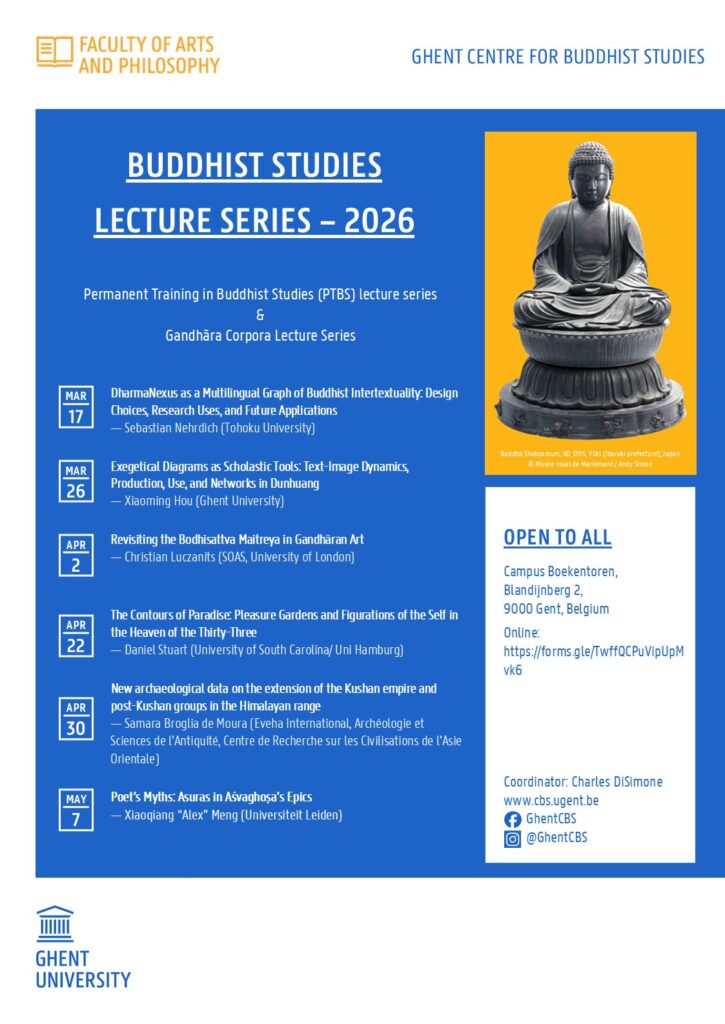
We are very happy to announce a mini-workshop on Digital Humanities, with a focus on the use of digital tools and AI in the editing of Buddhist texts and manuscripts.
Time: MAY 22nd, 2026
Location: Ghent University, Blandijnberg 2, Room 5.50 (5th floor)
Our featured speakers are Prof. Kiyonori Nagasaki and Dr. Wang Yifan.
GCBS researchers Prof. Dr. Christoph Anderl, Dr. Laurent Van Cutsem, Dr. Mariia Lepneva, and Chentong Liu presented their Digital Humanities projects, including the Ghent Database of Medieval Chinese (GDMC) and the new project on Anyue district (Sichuan province, China) Buddhist sites, TEI markup of electronic editions of Dunhuang manuscripts, social network analysis of Buddhist community in early modern China, as well as GIS mapping of Buddhist sites in Anyue and AI-powered system of identification of Buddhist images.

“Scholarly Editing in the Age of AI: Navigating Uncertainty through the Compilation of Buddhist Canons”
(Prof. Kiyonori NAGASAKI)
This presentation explores the role of AI in scholarly editing through the case of Buddhist canon compilation. Focusing on the SAT Daizōkyō Text Database Project and related efforts toward the Reiwa Tripitaka, it examines how AI-OCR, OCR correction systems, and retrieval-augmented generation (RAG) can support the creation of reliable digital scholarly texts. The talk argues that AI should not be understood as a replacement for scholarly judgment, but as a means of restructuring editorial workflows. In particular, AI-OCR can assist in the large-scale transcription of printed and woodblock Buddhist texts, while correction interfaces can make errors, variants, and editorial decisions more visible and manageable. Generative AI and RAG-based systems further open new possibilities for searching, comparing, and interpreting large textual corpora, though they also introduce new forms of uncertainty concerning reliability, provenance, and accountability. By situating these technologies within the long tradition of Buddhist canon compilation, the presentation considers how standards such as TEI and IIIF can help create transparent, verifiable, and reusable research infrastructures. It argues that scholarly editing in the age of AI must be understood not simply as the production of corrected texts, but as the design of systems for navigating uncertainty.
“The Blessing and Curse of Digitization for Historical East Asian Texts”
(Dr. WANG Yifan)
Modern text digitization schemes are fundamentally grounded in the synchronic state of writing systems and orthographies from the latter half of the twentieth century, operating under the governance of international information standards. While this foundational framework impacts the encoding of historical texts worldwide, it presents distinct challenges for East Asian languages, particularly those utilizing the Chinese (Han) script. Meanwhile, the study of pre-printing Chinese orthographic systems has recently garnered increased academic attention, only the establishment of robust quantitative methodologies to analyse them remaining an ongoing endeavor. Against the backdrop of these two relatively remote topics, this presentation provides an overview of the current landscape and the specific challenges posed by contemporary computational environments. Conversely, it discusses on a paradigm shift and positive perspectives granted by the open data era and recent technological progress, highlighting insights and methodologies from my own recent research.
Kiyonori Nagasaki is a Professor in the Faculty of Letters at Keio University and Senior Researcher at the International Institute for Digital Humanities. His work focuses on Digital Humanities, Buddhist Studies, and the development of digital research infrastructures for textual scholarship. He has been actively involved in the SAT Daizōkyō Text Database Project and in the promotion of international standards such as TEI, IIIF, and Unicode for East Asian classical texts. His current work explores how AI-OCR, structured text encoding, and digital scholarly editing can support the compilation, sharing, and long-term preservation of Buddhist canonical texts.
Yifan Wang 王一凡 is a Research Fellow at the International Institute for Digital Humanities and a Postdoctoral Research Fellow at the National Institute for Japanese Language and Linguistics. He holds an MA in linguistics and a PhD in library and information sciences from the University of Tokyo. For a decade, he has contributed to the SAT project, focusing on digitizing the Taishō Tripiṭaka (Chinese Buddhist scriptures) and researching medieval character dictionaries. He also actively participates in standardization, serving as an Ideographic Research Group (IRG) expert for ISO/IEC 10646 and Unicode, and as a Working Group expert within ISO/TC 37.




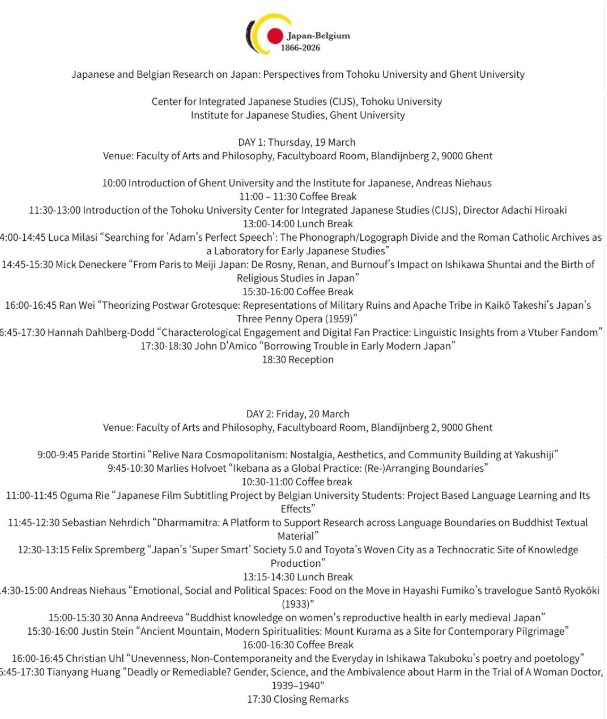


 GCBS’s former member Dr.