Doctoral School “Chinese Writing and Lexicography in Medieval China”, October 8-12, 2018

Abstract

This Doctoral School will address key questions concerning medieval Chinese writing practices and manuscript culture, in addition to providing an introduction to important historical lexicographical material. As such, the course will address essential issues concerning the research of and work with medieval Chinese source materials.

Description

The course is aimed at PhD students specializing in medieval China and medieval Chinese texts and manuscripts (focusing on the period between 5th and 10th century), as well as various aspects of Chinese writing. The course will enhance the PhD students’ understanding of the highly complex mechanisms concerning the production of Chinese handwritten manuscripts and the multifaceted use of Chinese characters. In addition to a general introduction to issues of Chinese writing (with a focus on Medieval Chinese), the discussion and reading of important source materials (e.g., Dunhuang manuscripts) will be one of the focal points of the lectures. Several aspects of medieval Chinese handwriting will receive special attention, such as phenomena of “standardization” and “variation”, the phonetic use of Chinese characters in manuscripts (phonetic loans / phonophoric elements), as well as historical material on the acquisition of writing / writing exercises among the Dunhuang findings. This will enable the students to gain a clearer understanding of medieval writing practices, help them in their critical approach to source materials, and concretely enhance their ability to decipher historical textual material. In the second part of the course, questions of lexicographical encoding, Chinese characters classification, and the organization of lexicographical material will be discussed. This part aims at helping the students to become familiar with the structure of these works, and enabling them to make use of this important type of source material. The course will also provide the opportunity for discussions with the PhD students and individual tutoring.

Instructors/lecturers

Prof. Imre GALAMBOS – Cambridge University – Faculty of Asian and Middle Eastern Studies – University of Cambridge – Sidgwick Avenue, Cambridge CB3 9DA, UK
Imre Galambos is one of the world’s leading experts on the development of Chinese writing. Besides being an expert in Ancient Chinese writing, he has worked extensively on many aspects of the palaeography of medieval Dunhuang manuscripts, as well as manuscript culture. From 2002-2016 he was the Project Manager of the large International Dunhuang Project at the British Library, London, one of the world’s largest depositories comprising of 10.000s of Dunhuang manuscripts. Since recently, he has also been the President of the European Association for the Study of Chinese Manuscripts.

Supporting lecturers
Dr. Christoph Anderl and Dr. Ann Heirman

Time Schedule and Venue

October 8 to October 12, 2018

Venuehet Pand, Onderbergen 1, 9000 Gent, room Jan Gillis

  • Monday, October 8th

09:30: Welcome of the participants by the Doctoral School organizers (Christoph AnderlAnn Heirman)

* 10:00 – 12:00: General introduction to Chinese writing (Imre Galambos)

12:00 – 13:30: lunch break

13:30 – 15:00: Introduction: Aspects of writing practices in Dunhuang manuscripts (Imre Galambos)

15:15 – 16:45: Dunhuang manuscripts containing writing exercises / “schooling” manuscripts (Imre Galambos)

  • Tuesday, October 9th

10:00 – 12:00: Outside influences in Chinese writing (Imre Galambos)

12:00 – 13:30: lunch break

13:30 – 15:30: Segmentation and presentation of Chinese texts / text readings (Imre Galambos)

  • Wednesday, October 10th

10:00 – 13:00: Aspects of “standard and variation” (Imre Galambos)

13:00 – 14:00: lunch break

14:00 – 17:00 Discussion / meetings with students, Q+A / presentation of a selection of PhD projects on writing (Imre GalambosChristoph Anderl)

  • Thursday, October 11th

* 10:00 – 12:00: Chinese medieval lexicography: An introduction / presentation of the Ghent Database of Medieval Chinese Texts (Christoph Anderl)

12:00 – 13:30: lunch break

13:30 – 15:30: The structure of the 10th century dictionary Longkan shoujing (Christoph Anderl)

  • Friday, October 12th

* 10:00 – 12:00: Reading of selected passages of the LKSJ (Christoph Anderl)

12:00 – 13:30: lunch break

13:30 – 15:00: Phonophoric elements in the classification system of LKSJ (Christoph Anderl)

15:15 – 17:00: Final discussions with students / short presentations of student projects (Christoph AnderlAnn Heirman)

* Lectures also suitable for a more general audience (including PhD students of general linguistics, etc.)


Doctoral school “Buddhism and Silk Culture”, May 28-June 1, 2018

Abstract: Doctoral school on “Buddhism and Silk Culture” features Stuart Young as a guest lecturer. The course aimed to enhance the PhD researchers’ understanding of key questions pertaining to the role of Buddhism in these contexts. While offering a thorough analysis of essential text material in the Chinese medieval period, the instructor, assisted by the organizers, will also introduce specific methodologies of research in medieval Chinese Buddhism, from an East Asian historical, as well as from a religious perpsective.
  • May 28 – June 1, 2018

Venuehet Pand, Onderbergen 1, 9000 Gent

  • DAY 1: Monday 28 May, 2018 (lunch break 12:00-13:30)

09:30: Welcome of the participants by the Doctoral School organizers (Ann Heirman, Christoph Anderl)
10:00 – 12:00: Course overview: Buddhism in the silk cultures of medieval China; The Chinese history, technology, and vocabulary of silk and sericulture* (lecture, with active participation)
12:00 – 13:30: lunch break
13:30 – 15:30: Research sources primary and secondary, textual, visual, and material; Archaeology of Chinese Silk, Dunhuang 敦煌 and Famensi 法門寺 (interactive presentation and discussion of sources)

  • DAY 2: Tuesday 29 May, 2018 (lunch break 12:00-13:30)

10:00 – 12:00: Vinaya and material culture (Ann Heirman)* (lecture with active participation)
12:00 – 13:30: lunch break
13:30 – 15:30: Silk in the Vinaya (disciplinary monastic rules) and Chinese Vinaya Commentaries (1: Dharmaguptaka)

  • DAY 3: Wednesday 30 May, 2018 (lunch break 12:00-13:30)

10:00 – 12:00: Silk in the Vinaya and Chinese Vinaya Commentaries (2: Sarvāstivāda and Mahīśāsaka)
12:00 – 13:30: lunch break
13:30 – 15:30: Discussion with students, Q+A

  • DAY 4: Thursday 31 May, 2018 (lunch break 12:00-13:30)

10:00 – 12:00: Daoxuan’s 道宣 (596-667) Xingshi chao 行事鈔 commentary on the silk bedding precept
12:00 – 13:30: lunch break
13:30 – 15:30: Daoxuan’s commentaries in comparison with Dajue大覺 (fl. 712)

  • DAY 5: Friday 1 June, 2018 (lunch break 12:00-13:30)

10:00 – 12:00: Chinese views of silk in India: travelogues, hagiographies, miracle tales (1)
12:00 – 13:30: lunch break
13:30 – 15:00: Chinese views of silk in India: travelogues, hagiographies, miracle tales (2)
15:00 – 16:00: Final discussions with students (Stuart Young, Ann Heirman, Christoph Anderl)

* Lectures also suitable for a more general audience (including PhD students of (art) history, etc.)

This doctoral school was generously sponsored by the Tianzhu Buddhist Network.

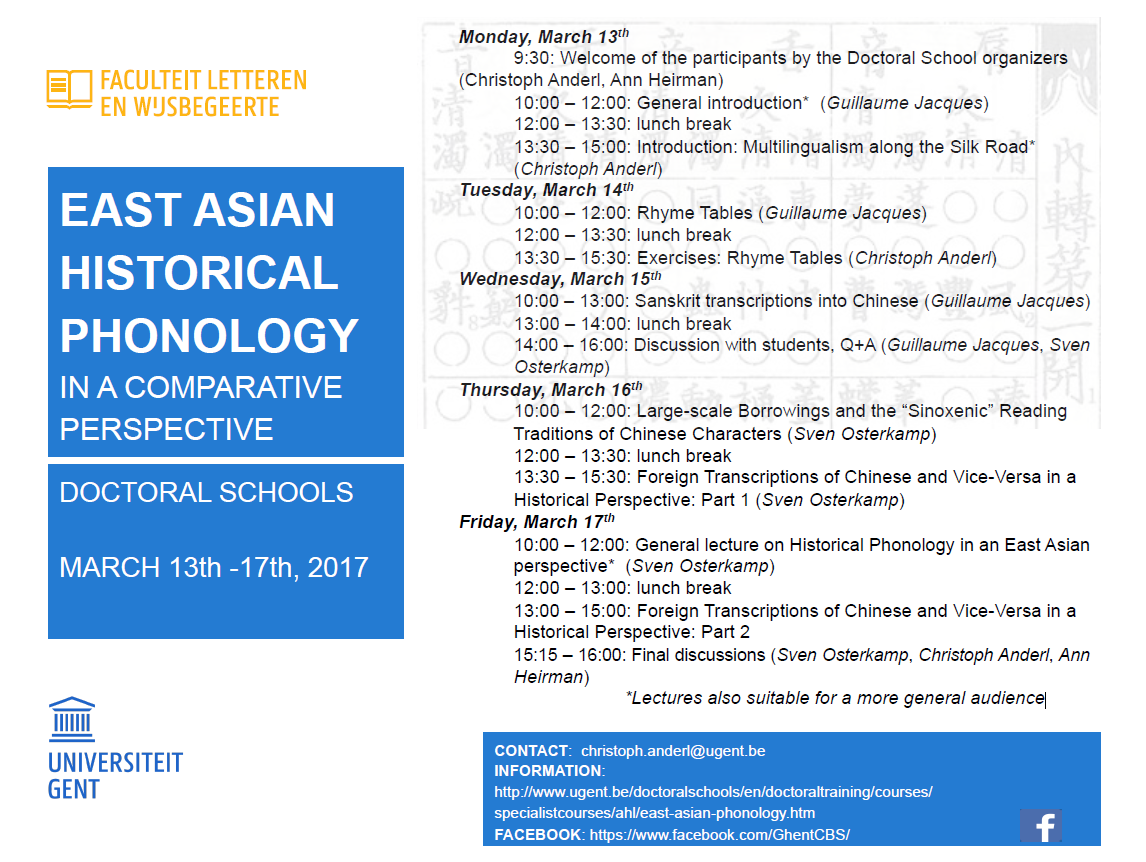
Doctoral School “East Asian Historical Phonology in a Comparative Perspective”, March 13-17, 2017

This Doctoral School is open to a limited number of external PhD students (free of charge)! For more information, please contact christoph.anderl@ugent.be.


Monday, March 13th
9:30: Welcome of the participants by the Doctoral School organizers (Christoph Anderl, Ann Heirman)
10:00 – 12:00: General introduction* (Guillaume Jacques)
12:00 – 13:30: lunch break
13:30 – 15:00: Introduction: Multilingualism along the Silk Road* (Christoph Anderl)

Tuesday, March 14th
10:00 – 12:00: Rhyme Tables (Guillaume Jacques)
12:00 – 13:30: lunch break
13:30 – 15:30: Exercises: Rhyme Tables (Christoph Anderl)

Wednesday, March 15th
10:00 – 13:00: Sanskrit transcriptions into Chinese (Guillaume Jacques)
13:00 – 14:00: lunch break
14:00 – 16:00: Discussion with students, Q+A (Guillaume Jacques, Sven Osterkamp)

Thursday, March 16th
10:00 – 12:00: Large-scale Borrowings and the “Sinoxenic” Reading Traditions of Chinese Characters (Sven Osterkamp)
12:00 – 13:30: lunch break
13:30 – 15:30: Foreign Transcriptions of Chinese and Vice-Versa in a Historical Perspective: Part 1 (Sven Osterkamp)

Friday, March 17th
10:00 – 12:00: General lecture on Historical Phonology in an East Asian perspective* (Sven Osterkamp)
12:00 – 13:00: lunch break
13:00 – 15:00: Foreign Transcriptions of Chinese and Vice-Versa in a Historical Perspective: Part 2
15:15 – 16:00: Final discussions (Sven Osterkamp, Christoph Anderl, Ann Heirman)
*Lectures also suitable for a more general audience


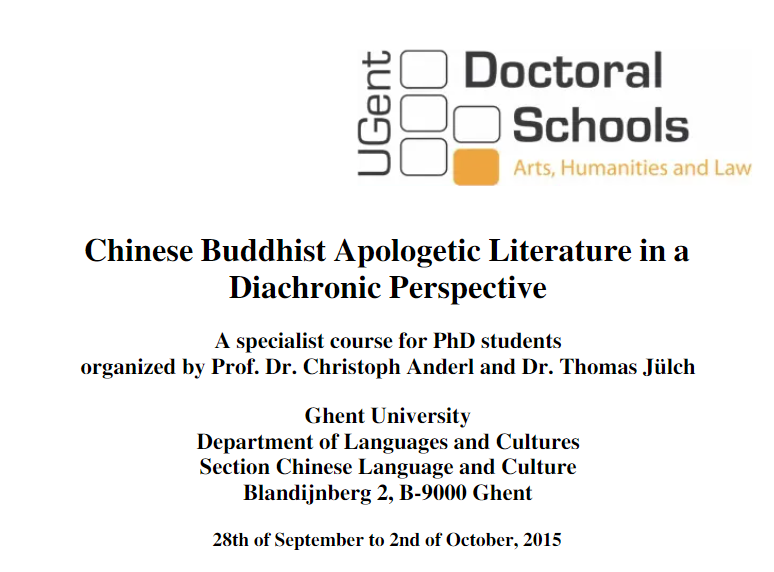
Doctoral School “Chinese Buddhist Apologetic Literature in aDiachronic Perspective”, September 28 – October 2, 2015

Abstract: The course will introduce Chinese Buddhist apologetic texts from two different periods. Dr. Jülch will deal with the Zhenzheng lun 甄正論 written in the Tang dynasty, and Dr. Zhang with the Dayuan zhiyuan bianwei lu 大元至元辨偽録 written in the Yuan dynasty. In the course, selected parts of the texts will be translated, their historical background analyzed, and methodological issues discussed.

“Chinese Buddhist Apologetic Literature in a Diachronic Perspective” – A specialist course for PhD studentsorganized by Prof. Dr. Christoph Anderl and Dr. Thomas Jülch

Ghent University, Department of Languages and Cultures, Section Chinese Language and Culture, Blandijnberg 2, B-9000 Ghent

28th of September to 2nd of October, 2015

The organizers of the course cordially invite PhD students of Ghent University, as well asfrom other universities, to participate in this training course taught by Dr. Thomas Jülch (Ghent University) and Dr. Zhang Dewei (University of Macao). Participation is free of charge.

The course will introduce Chinese Buddhist apologetic texts from two different periods. Dr. Jülch will deal with the Zhenzheng lun 甄正論 written in the Tang dynasty, and Dr. Zhang with the Dayuan zhiyuan bianwei lu 大元至元辨偽録 written in the Yuan dynasty. In the course, selected parts of the texts will be translated, their historical background analyzed, and methodological issues discussed. On Monday, the 28th of September, we will begin with a short welcome at 09:30. The subsequent schedule will remain the same for all course days (Monday to Friday):

10:00 – 12:00: morning session;

12:00 – 13:00: lunch break;

13:00 – 15:00: afternoon session

Proceedings / Locations:

Monday, 28th of Sept.; topic: Zhenzheng lun; room: Plateau-Rozier, D2. 20

Tuesday, 29th of Sept.; topic: Zhenzheng lun; room: Plateau-Rozier, D2.43

Wednesday, 30th of Sept.; topic: morning: Zhenzheng lun, afternoon: Dayuan zhiyuanbianwei lu; room: Plateau-Rozier, D2.20

Thursday, 1st of Oct.; topic: Dayuan zhiyuan bianwei lu; room: Plateau-Rozier, D2.43

Friday, 2nd of Oct.; topic: Dayuan zhiyuan bianwei lu; room: Plateau-Rozier, D2.43

International students are welcome to participate in the course! For more information, questions, and registration, please contact Dr. Thomas Jülch (Email: Thomas.Julch@UGent.be)