Abstract: The course will introduce Chinese Buddhist apologetic texts from two different periods. Dr. Jülch will deal with the Zhenzheng lun 甄正論 written in the Tang dynasty, and Dr. Zhang with the Dayuan zhiyuan bianwei lu 大元至元辨偽録 written in the Yuan dynasty. In the course, selected parts of the texts will be translated, their historical background analyzed, and methodological issues discussed.
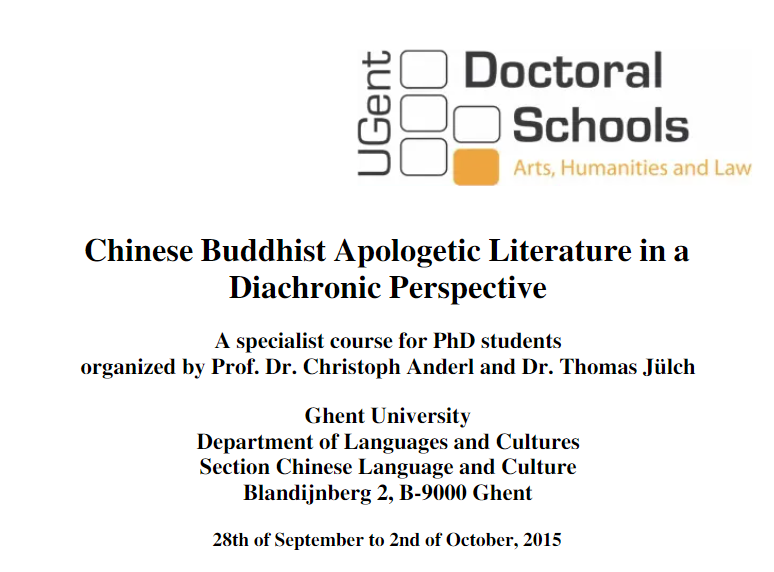
“Chinese Buddhist Apologetic Literature in a Diachronic Perspective” – A specialist course for PhD studentsorganized by Prof. Dr. Christoph Anderl and Dr. Thomas Jülch
Ghent University, Department of Languages and Cultures, Section Chinese Language and Culture, Blandijnberg 2, B-9000 Ghent
28th of September to 2nd of October, 2015
The organizers of the course cordially invite PhD students of Ghent University, as well asfrom other universities, to participate in this training course taught by Dr. Thomas Jülch (Ghent University) and Dr. Zhang Dewei (University of Macao). Participation is free of charge.
The course will introduce Chinese Buddhist apologetic texts from two different periods. Dr. Jülch will deal with the Zhenzheng lun 甄正論 written in the Tang dynasty, and Dr. Zhang with the Dayuan zhiyuan bianwei lu 大元至元辨偽録 written in the Yuan dynasty. In the course, selected parts of the texts will be translated, their historical background analyzed, and methodological issues discussed. On Monday, the 28th of September, we will begin with a short welcome at 09:30. The subsequent schedule will remain the same for all course days (Monday to Friday):
10:00 – 12:00: morning session;
12:00 – 13:00: lunch break;
13:00 – 15:00: afternoon session
Proceedings / Locations:
Monday, 28th of Sept.; topic: Zhenzheng lun; room: Plateau-Rozier, D2. 20
Tuesday, 29th of Sept.; topic: Zhenzheng lun; room: Plateau-Rozier, D2.43
Wednesday, 30th of Sept.; topic: morning: Zhenzheng lun, afternoon: Dayuan zhiyuanbianwei lu; room: Plateau-Rozier, D2.20
Thursday, 1st of Oct.; topic: Dayuan zhiyuan bianwei lu; room: Plateau-Rozier, D2.43
Friday, 2nd of Oct.; topic: Dayuan zhiyuan bianwei lu; room: Plateau-Rozier, D2.43
International students are welcome to participate in the course! For more information, questions, and registration, please contact Dr. Thomas Jülch (Email: Thomas.Julch@UGent.be)
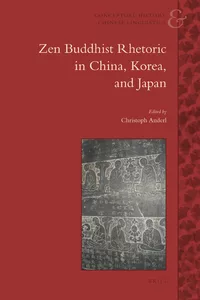 One of the key factors for the success of the Chán/Sǒn/Zen schools in East Asia was the creativity of their adherents concerning the development of innovative literary genres and the skillful application of linguistic and rhetorical devices in their textual products. From the very beginning, Zen Buddhists used literature in order to attract the attention and support of influential lay Buddhists, such as literati, officials, and members of the aristocracy. Consequently, Zen Buddhist texts had a deep and lasting impact on the development of East Asian languages, literary genres, and rhetorical devices, and more generally, on East Asian culture. In this volume, leading specialists in East Asian Buddhism and linguistics analyze the interplay of language and doctrine/ideology in Chinese Chán, Korean Sŏn, and Japanese Zen, as well as tracing developments triggered by changes in the respective sociopolitical and socio-religious contexts. As a special focus, Zen rhetoric will be related to pre-Chán Buddhist literary developments in India and China, in order to trace continuities and changes in the application of rhetorical strategies in the overall framework of Buddhist literary production. Through this diachronic and comparative approach, the great complexity and the multifaceted features of Chán/Sŏn/Zen literature is revealed.
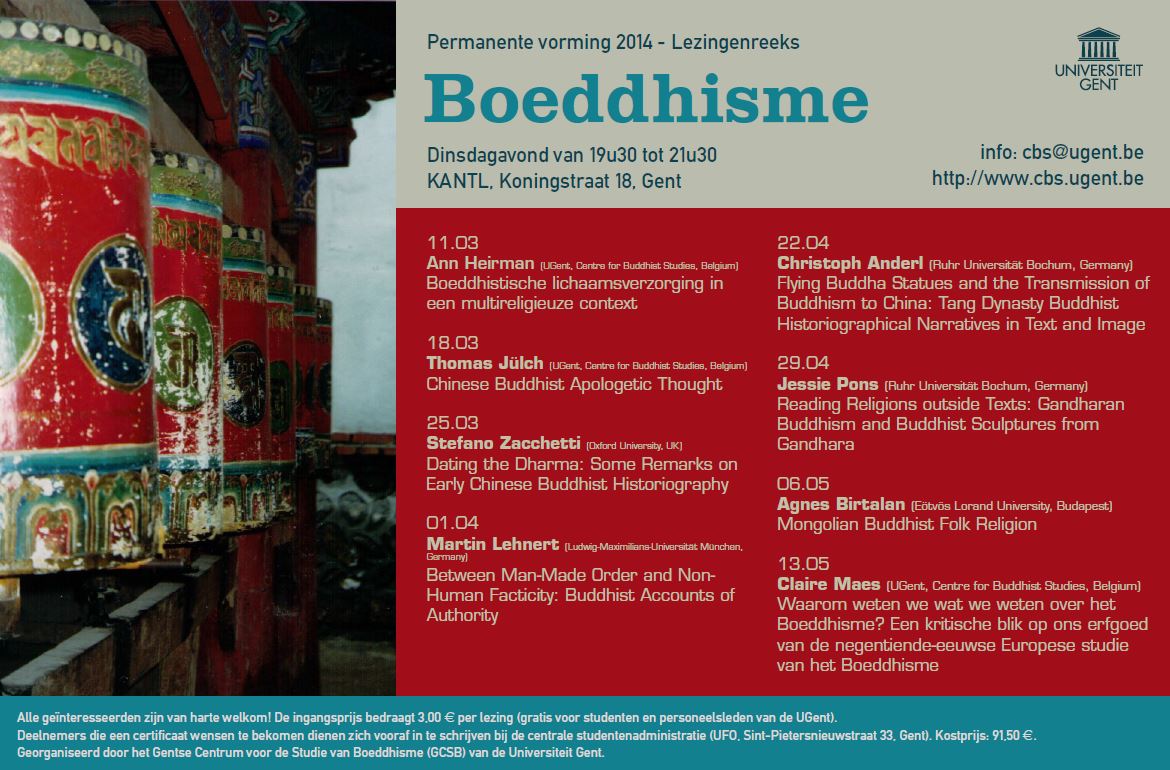
 Buddhist monasteries, in both Ancient India and China, have played a crucial social role, for religious as well as for lay people. They rightfully attract the attention of many scholars, discussing historical backgrounds, institutional networks, or influential masters. Still, some aspects of monastic life have not yet received the attention they deserve. This book therefore aims to study some of the most essential, but often overlooked, issues of Buddhist life: namely, practices and objects of bodily care. For monastic authors, bodily care primarily involves bathing, washing, cleaning, shaving and trimming the nails, activities of everyday life that are performed by lay people and monastics alike. In this sense, they are all highly recognizable and, while structuring monastic life, equally provide a potential bridge between two worlds that are constantly interacting with each other: monastic people and their lay followers. Bodily practices might be viewed as relatively simple and elementary, but it is exactly through their triviality that they give us a clear insight into the structure and development of Buddhist monasteries. Over time, Buddhist monks and nuns have, through their painstaking effort into regulating bodily care, defined the identity of the Buddhist saṃgha, overtly displaying it to the laity.