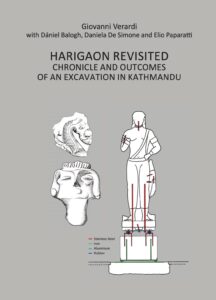
 Giovanni Verardi, Dániel Balogh, Daniela De Simone and Elio Paparatti. Harigaon revisited: chronicle and outcomes of an excavation in Kathmandu. Kathmandu: Vajra Publications, 2023
The idea of writng this book stemmed out from the need to rethink an excavation carried out in Kathmandu in years now distant from the people who took part in it and even more distant from the recent history of Nepal. Today the Valley of Kathmandu is a profoundly different place from what it was in the 1980s, and in many ways unrecognisable. The idea of the book, however, is also due to the long-term consequences of the situation created in Italy between 2008 and 2011, the year in which the Istituto Italiano per l’Africa e l’Oriente (IsIAO), sonship of the Istituto Italiano per il Medio ed Estremo Oriente (IsMEO), closed down. The latter had been established in 1933 by Giovanni Gentile and then directed for a long time by Giuseppe Tucci. Both Institutes, as far as field activities in Asia were concerned, were in close relationship with the Museo Nazionale di Arte Orientale, where the documentation of the excavations was deposited, in particular the graphic and photographic material (drawings of all kinds, negatives and prints). In 2016 the Museum left its headquarters in the very central Via Merulana in Rome and was joined to the Museo Nazionale Preistorico Etnografico Luigi Pigorini, merging into the new Museo delle Civiltà, where today the largest part of the documentation of the archaeological undertakings of the past is kept, waiting to be rearranged and made usable.
 GANDHĀRA CORPORA – Charles DiSimone

 Within the framework of his research stay at Ghent Centre for Buddhist Studies,
  Buddhist monasteries, in both Ancient India and China, have played a crucial social role, for religious as well as for lay people. They rightfully attract the attention of many scholars, discussing historical backgrounds, institutional networks, or influential masters. Still, some aspects of monastic life have not yet received the attention they deserve. This book therefore aims to study some of the most essential, but often overlooked, issues of Buddhist life: namely, practices and objects of bodily care. For monastic authors, bodily care primarily involves bathing, washing, cleaning, shaving and trimming the nails, activities of everyday life that are performed by lay people and monastics alike. In this sense, they are all highly recognizable and, while structuring monastic life, equally provide a potential bridge between two worlds that are constantly interacting with each other: monastic people and their lay followers. Bodily practices might be viewed as relatively simple and elementary, but it is exactly through their triviality that they give us a clear insight into the structure and development of Buddhist monasteries. Over time, Buddhist monks and nuns have, through their painstaking effort into regulating bodily care, defined the identity of the Buddhist saṃgha, overtly displaying it to the laity.