Two GCBS researchers have been granted prestigious FWO Senior Research projects

Two GCBS researchers have been granted two prestigious 4-year FWO Senior Research projects!

(1) “Visual and Textual Narratives of Buddhist Initiation Rituals in Medieval China”

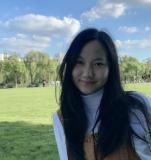
Applicants: Prof. Ann Heirman & Christoph Anderl / Researcher: Dr. Anna Sokolova

(2) “Tracing Macro-cyclical Change Through Micro-cycles in Historical Chinese”

Applicants: Prof. Anne Breitbarth & Christoph Anderl & Linda Badan / Researcher: Anni Wang

Publication highlights (Q4 2024): “Buddhakṣetrapariśodhana”, edited by Charles DiSimone and Nicholas Witkowski.

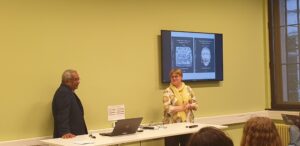
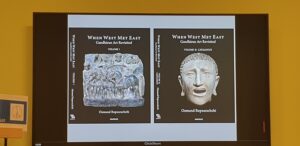
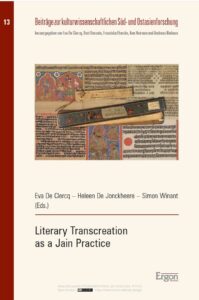
New Book Announcement: Buddhakṣetrapariśodhana: A Festschrift for Paul Harrison, edited by GCBS professor Charles DiSimone and Nicholas Witkowski.

From the publisher:

Buddhakṣetrapariśodhana is a volume in honor of the Buddhologist and Philologist, Paul M. Harrison, George Edwin Burnell Professor of Religious Studies at Stanford University. The contributions of twenty-nine of his colleagues, students, and friends from across the globe are dedicated to his academic interests and represent a cross-section of the disciplines that have been so heavily influenced by Paul Harrison’s scholarship in the past decades: Buddhist Studies, Indology, Sinology, Tibetology, and Art History.

Prof. DiSimone’s contribution “An Illuminated Palm-leaf Aṣṭasāhasrikā Prajñāpāramitā Manuscript Folio Circa 1130–60 CE” is available online.

Fieldwork of GCBS researcher Ven. Hui Wen

Venerable Hui Wen, a Phd student at GCBS, has just completed a field trip to the Mogao 莫高 caves in Dunhuang 敦煌, Gansu Province, in the framework of her research on the iconography and symbolic representations found at the center parts of the ceilings of Mogao caves. She also met the researchers of Dunhuang Academy, including her co-supervisor Prof. Neil Schmid, and worked in the academy’s library.

Hui Wen with researchers from Dunhuang, including her co-supervisor Prof. Neil Schmid (Professor at the Dunhuang Academy)
At the entrance to the Mogao cave complex (consisting of more than 500 caves with wall paintings)
Work in the Library of the Dunhuang Academy

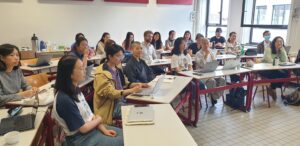
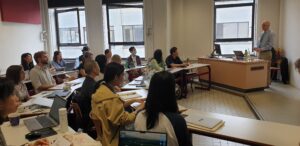
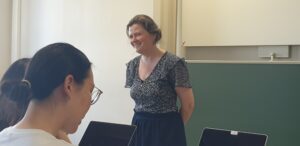
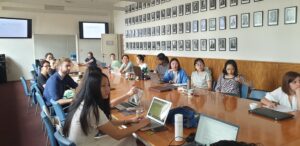
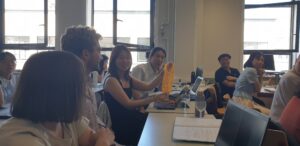
Reading group meeting, presentation by Longyu Zhang, November 8, 2024

GCBS reading group activities began on November 8 this year. PhD student Longyu Zhang presented her preliminary reading of narrative passages from Dharmaguptaka-vinaya, with a focus on the use of modal markers in these texts. Longyu began by introducing the terminological apparatus she uses for analysing necessity, possibility, and volition. During the rest of the session, we immersed ourselves in the analysis of specific examples, narrowing down our interpretations as we got acquainted with the unfolding of the story.

New member: August Sundin

August Sundin is PhD candidate in Buddhist Studies within the Department of Languages and Cultures at Ghent University. He is a member of the project “Corpora in Greater Gandhāra. Tracing the development of Buddhist Textuality and Gilgit/Bamiyan manuscript networks in the first millennium of the common era” led by Professor Charles DiSimone.

August received his Bachelors in Buddhist Studies and Masters in Tibetan Translation from Kathmandu University in Nepal. His past research has focused on the role of cultural interpretation in Indo-Tibetan historiographical works as well as the issues of reading Indic materials in their Tibetan translations. August’s current research focuses on the application of philology and textual comparison to Buddhist manuscripts and the history of Buddhist textual networks centred in Gandhāra between the fourth and ninth centuries c.e.

Indian ambassadors’s visit, October 10, 2024

On 10th October, Mr Saurabh Kumar, Ambassador of India to Belgium and Luxembourg, and to the European Union, accompanied by Mr Venkateswaran Narayanan, First Secretary Press, Information and Culture visited Universiteit Gent to meet the Rector, Prof Rik Van de Walle, and the members of our research group and learn more about our work, and current and future activities. GCBS’s Professors Ann Heirman, Charles DiSimone, and Daniela De Simone  attended the meeting.

A splendid opening ceremony launches the exhibition “Sensing the Buddha”

The  exhibition “Sensing the Buddha” opened in the Domaine & Musée royal de Mariemont on Friday, September 21, 2024. Madam Minister of Culture, Elisabeth Degryse, Her Excellency Madam Kanchana Patarachoke, Ambassador of Thailand in Belgium, Madam Deputy Culture.be – Fédération Wallonie-Bruxelles Mr. Frédéric Delcor, Secretary General of the Ministry of Sophie Pécriaux as well as Mrs. Jeanne Brunfaut, General Administrator of Fédération Wallonie-Bruxelles/Officiel attended the opening ceremony. Congratulations to the exhibition curators, Lyce Jankowski, Lara Bauden and Ann Heirman Ghent Centre for Buddhist Studies for this great success. The exhibition will last until April 20, 2025..

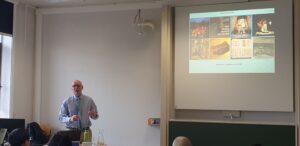
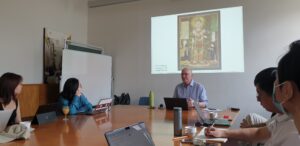
Guest lecture “Monastic Monsters: Historicizing Outcaste Characters in the Grotesquerie of Indian Buddhist Literature” by Nicholas Witkowski, October 3, 2024

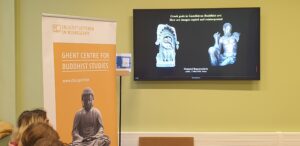
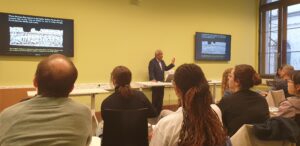
The Gandhāra Corpora Project, South Asia Network Ghent, and Ghent Centre for Buddhist Studies present a lecture by Professor Nicholas Witkowski from the University of San Diego.

Title: Monastic Monsters: Historicizing Outcaste Characters in the Grotesquerie of Indian Buddhist Literature

Speaker:  Nicholas Witkowski, University of San Diego

Date and Time: October 3, 2024, at 16:00

Location: Faculteitszaal, Blandijn, faculteit Letteren en Wijsbegeerte, Blandijnberg 2, 9000 Gent

Abstract: This presentation forms one pillar of a broader project to write the history of outcaste Buddhism drawing upon texts from the Buddhist legal codes (Vinaya). There is an assumption, implicit in much of early Buddhist material, as well as in much of modern scholarship, that Buddhism is primarily an upper-caste affair. In other words, the field effectively operates as though outcaste Buddhist communities lacked the agential capacity to shape the institutional and soteriological landscape of South Asian Buddhism. Articulating the contours of outcaste influence, or even presence, can prove difficult, as many cases in the Vinaya tend to mask caste status. In this presentation, I will focus on a particular Vinaya case about a monastic monster—a sexually deviant figure—in order to propose a methodological approach to reading for outcaste monastics. As postcolonial studies of colonial literature have argued, the discourse of sexual deviancy is often code for subaltern fugitivity—in this case, fugitivity from the socio-economic fetters of caste. This presentation will argue that we may read cases of sexual deviancy among monks in the Vinaya as a discursive index of upper-caste anxiety about the presence of outcaste communities in the monastery.

About the Speaker: Nicholas Witkowski is Assistant Professor of Buddhist Studies at the University of San Diego. His current project, Lifestyles of Impurity, is a study of low-/outcaste monastic communities in first millennium South Asia that employs the theoretical armature of historians of the everyday. This book project integrates feminist, Marxist, post-colonialist, and Foucauldian literary-critical approaches to the study of textual sources documenting the socio-religious practices of low-/outcaste communities. What Dr. Witkowski hopes to convey is a nuanced articulation of the social locations of marginality as wellsprings of cultural innovation that continued to resist, challenge, and, in certain key respects, transform Brahmanical imperial discourse and practice across the Sanskrit cosmopolis throughout the first millennium CE.


Publication highlights (Q3 2024): Two papers by GCBS members in the Journal of Chinese Buddhist Studies

Articles from two GCBS researchers have just been published in the Journal of Chinese Buddhist Studies, Volume 37,  Special issue “Chinese Buddhist Monastic Institutional Life and Buddhist Women’s Experience and Practice” (August 2024). One is by the Head of the GCBS, Prof. Dr. Ann Heriman, and the other by FWO postdoctoral fellow Dr. Mariia Lepneva. For details, see below.

Abstract. Buddhist texts generally prohibit the killing and harming of all sentient beings. This is certainly the case in vinaya (disciplinary) texts, which contain strict guidelines on the preservation of all human and animal life. When these texts were translated into Chinese, they formed the core of Buddhist behavioral codes, influencing both monastic and lay followers. Chinese masters, such as the highly influential Daoxuan 道宣 (596–667), wrote extensive commentaries on and accounts of the vinayas to ease the introduction of Buddhist concepts into the Chinese environment. These texts comprise rich sources of information on material culture in Buddhist monasteries and beyond.

The subject of this paper is oxen and their complex relations with human beings, as discussed in the disciplinary texts. Oxen were commonplace in both India and imperial China, where they were bred and reared for agricultural purposes, and as draft animals. Depending on the context, they could be perceived as annoying, filthy, or useful. They were associated with improper behavior, seen as helpful or even indispensable, or viewed as the innocent victims of human misbehavior.

Yet, all these considerations were overshadowed by the Buddhist proscription against harming or killing any sentient being. Hence, the focus of this paper is Daoxuan’s interpretation of this principle in relation to the treatment of oxen, informed by his reading of Indian normative texts and his own Chinese context. As we will see, his guidance was complex, but he always attempted to remain true to what was—and remains—a central tenet of Buddhism.

Abstract. The late Ming and early Qing periods witnessed a massive revitalization of Chinese Buddhism, particularly the booming rise of Chan lineages in the southern Jiangnan region throughout the seventeenth century. To date, scholarship has emphasized the continuity of this trend, largely uninterrupted by the dynasty transition. This paper supplements this picture by shifting the focus towards Beijing in the north and inquiring into the unusual two-lineage model that emerged at Guangji Monastery, which is nowadays well-known as the seat of the Buddhist Association of China, shortly after the establishment of Manchu rule. Quite different from the main institutional innovation of the late Ming—the dharma transmission monastery with a single Chan lineage at the head—this temple developed a power structure with the division of labor between an indigenous tonsure lineage and an invited ordination lineage. Based on a close reading of the gazetteer of Guangji Monastery, supplemented by other relevant sources, this paper traces the origins and evolution of this diarchic system. The findings show the members of the two lineages assumed three key roles in the monastery leadership. The tonsure lineage controlled the position of the prior, who was responsible for the general operation of the monastery. Moreover, it supplied informal leaders, who did not assume any administrative positions but became influential due to their asceticism, Chan lineage affiliation, and literary talent. This allowed them to significantly improve the wellbeing of the monastery through their ability to attract the patronage of scholar-officials. The ordination lineage controlled the abbotship, represented the monastery in the face of the emperors, carried out ordination ceremonies, and provided Vinaya instruction to monks. The continuous existence of this “two lineages with three roles” system despite suffering several major breaks testifies to its effectiveness and offers an example of an institutional model that allowed a Buddhist monastery to simultaneously house several prominent leaders with diverse expertise.

Exhibition “Sensing the Buddha,” 21 September 2024 to 20 April 2025, Royal Museum of Mariemont (Belgium)

In partnership with the Ghent Centre for Buddhist Studies, the Domaine & Musée royal de Mariemont has produced the exhibition “Sensing the Buddha,” an unprecedented immersion in the world of Buddhism. The exhibition features innovative scenography that reveals the many representations of Buddha, the Buddhist pantheon, and its rituals.

Practical information

Sensing the Buddha

Time: From 21 September 2024 to 20 April 2025

Place: Domain & Royal Museum of Mariemont

Address: Chaussée de Mariemont, 100, 7140 Morlanwelz, Belgique

  • Location in the museum: Exhibition on the 2nd floor of the Museum,
  • Mindfulness trail in the Domain,
  • Photo trail in the Domain and on the 1st floor of the Museum

Entrance fee: € 8 – possible reductions


Buddha – cultural landscape

The iconic Buddha figure is well-known in Western society. Often seen as a decorative element in homes and gardens, as a symbol of ‘zen’ or of an idealized vision of Asia, Buddha holds multitude meanings.

But are they truly understood? What are the true meanings and stories behind the images associated with the Buddha? What spirituality resides in the artworks and how do Buddhists view them?

To answer these questions, the exhibition features a participatory scenography; providing a visitor experience where art meets sensibility.

One buddha, many buddhas

“Sensing the Buddha” at Mariemont showcases nearly a hundred artefacts from the museum’s collections. This exceptional selection spans across Asia, including India, China, Japan, Myanmar, Thailand, and the Himalayas.

It is a unique opportunity to explore the diversity of Buddhist iconography and gain a fresh perspective on Buddha.

Mariemont collection

The works on display are made of bronze, ivory, wood, or lapis lazuli, and they emit a strong sense of presence and fascination. Raoul Warocqué -founder of the Royal Museum of Mariemont- played a significant role in establishing the Buddhist art collection as one of the cornerstones of his collection.

With this exhibition, Mariemont uncovers pieces that have not been publicly seen

 for nearly 65 years. As the collection was put in storage after the 1960 fire at the Chateau de Mariemont, previously unknown treasures are now unveiled, with some items specially restored for the event.

Additionally, rarely seen thangkas (Buddhist paintings) from the Léon Verbert collection, on loan from the Royal Museums of Art and History, are also presented.

A closer look

The Museum encourages a deeper exploration of Buddha, inviting to come closer, pause, and observe.

Offer a gift in the form of origami.

Feel a connection within the visual atmosphere of a sanctuary.

Reflect on and explore the practices, meditation and gestures of Buddhism.

“Sensing the Buddha” is more than an exhibition. It is a singular encounter with Buddhist art, an original experience combining history, art and sensibility.

Curated by

The exhibition is curated by Lyce Jankowski, Curator of the Section of Extra-European Arts and Lara Bauden, Scientific Assistant, at the Domaine & Musée royal de Mariemont & under the scientific supervision of Ann Heirman, Director of the Ghent Centre for Buddhist Studies – Universiteit Gent.